
FAQ

Straight answers before you decide whether to talk to TARS.

A good site should answer the obvious questions before it asks for your trust. This page is here to help you decide whether TARS is useful for your business, your workload, and the way you operate.
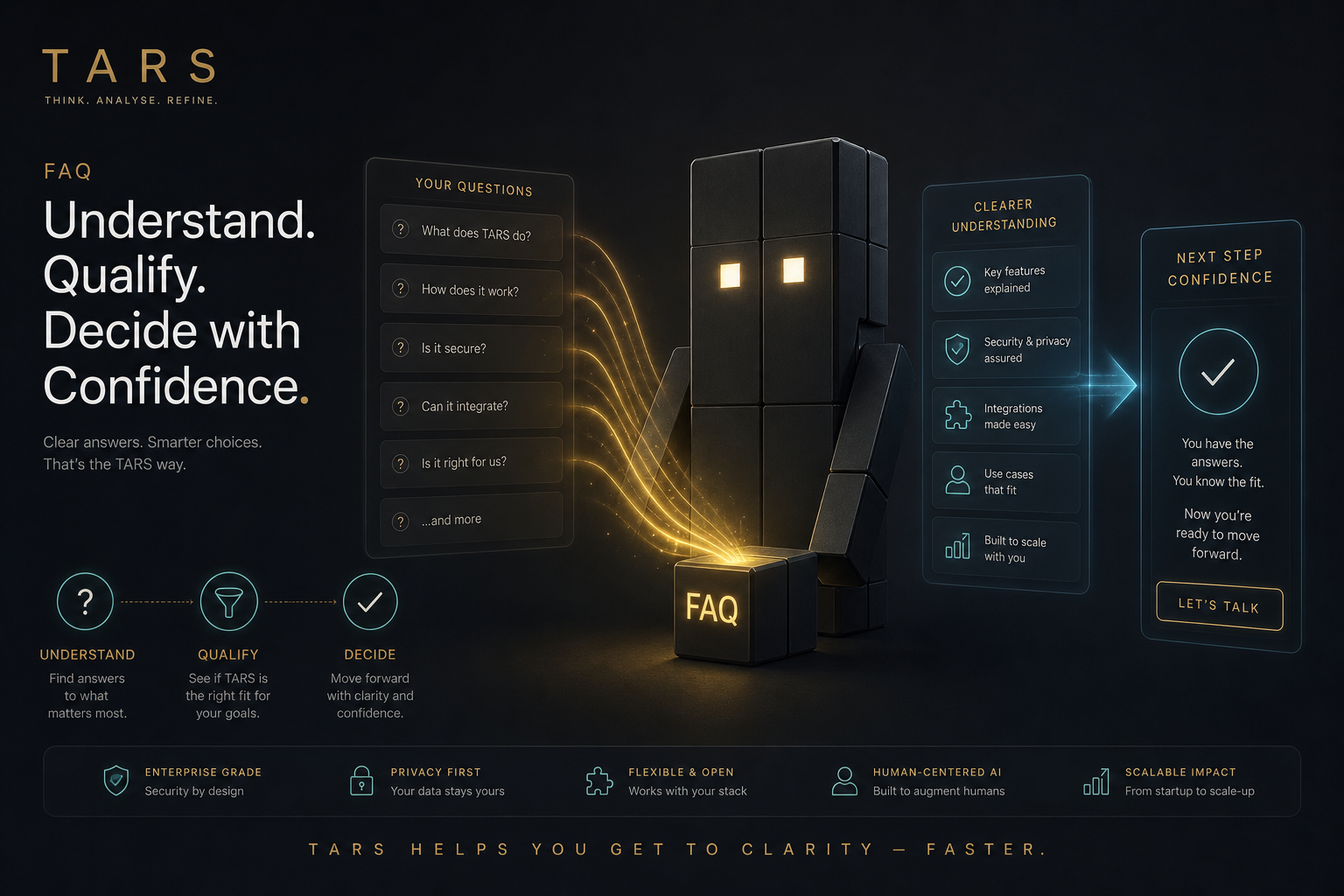
Infographic showing how the TARS FAQ helps visitors understand, qualify, and decide
The FAQ should do three things well: explain the model, clarify fit, and make the next decision easier.
What this page is for

Good questions should be answered before a business conversation starts.

When a site explains the brand but leaves the practical questions unanswered, the enquiry page has to work too hard. This page closes that gap and helps people decide whether the conversation is worth having.

If the same questions keep appearing, they deserve a clear public answer instead of being handled one message at a time.

Example engagements

Executive follow-through

For leaders and operators who are drowning in inbox residue, follow-ups, decision notes, and status drift across too many moving parts.

Research and decision support

For work that needs comparison, synthesis, verification, and a usable brief instead of another sprawling thread.

Private AI lanes and workflows

For teams that need controlled memory, recurring routines, and a real operating lane rather than one-off chat sessions.

Poor fit

Novelty demos, vague ownership, or pressure to improvise past trust boundaries. Those should stay elsewhere.

Common questions

What people should be able to learn without hunting.

Open any question. The aim is a clearer picture of what TARS does, where it fits, and where it does not.

TARS is a private AI operator built to carry context and move work forward across research, writing, planning, execution, and follow-through. It is more than chat. It is a working setup with memory, tools, routines, and verification.
TARS fits operators, founders, executives, and teams that are overloaded by fragmented work rather than a lack of raw software. It is strongest where context matters, follow-through matters, and the cost of dropped threads is real.
Serious work needs continuity, discretion, and durable context. A private setup makes it easier to keep memory clean, preserve preferences, maintain workflows, and improve the system without turning every session into rediscovery.
The goal is governed memory, not maximum memory. TARS uses layered memory, verification, retrieval rules, and maintenance so useful context stays available while stale or weak context does not quietly run the show.
By preferring proof over confidence. TARS is built to verify files, live pages, commands, and system state before speaking too confidently about what happened. That discipline matters more than polished wording.
Work that needs reckless confidence, vague ownership, or sensitive action without proper boundaries is a poor fit. TARS is designed for accountable execution, not improvising past trust limits.
The inquiry arrives as a structured brief. From there the next step is scoping: what lane is needed, what friction should be removed first, what boundaries matter, and whether a private deployment is the right shape at all.
Because the public surface should tell the truth about the product that exists today. The site needs to explain, publish, and route interest cleanly. Static infrastructure handles that well, stays easy to verify, and avoids borrowed complexity before it is earned.
Next step

If the questions are answered, the next useful move is to talk about your real situation.

Start an enquiry with the work that needs better follow-through, clearer thinking, or less friction.